
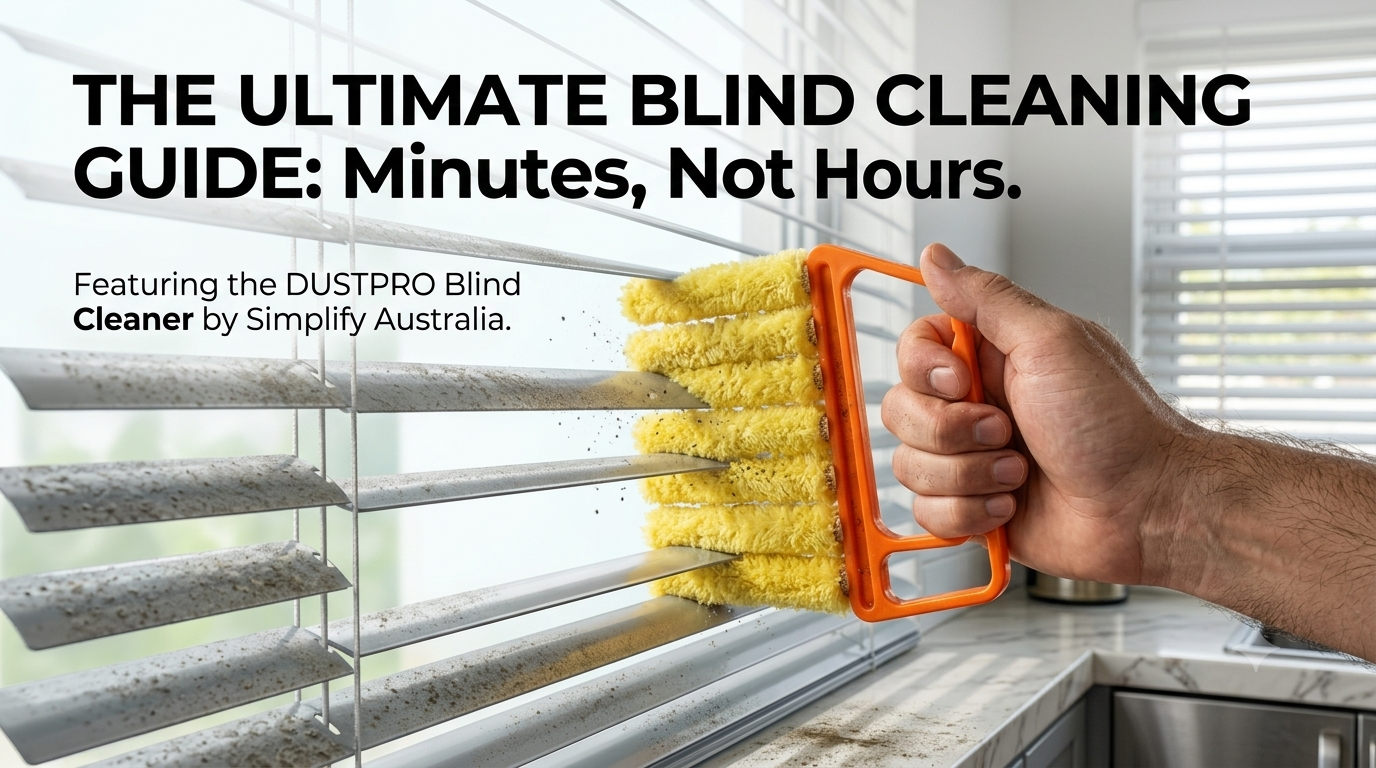
Blinds are one of the most popular window coverings in Australian homes — and one of the most neglected when it comes to cleaning. You wipe down the kitchen bench every day. You vacuum the floors every week. You wash the windows once a season. But the blinds? They sit there collecting dust, month after month, until someone runs a finger across a slat and leaves a visible trail through a thick grey film.
It's not that people don't want to clean their blinds. It's that cleaning blinds with conventional methods is so tedious, time-consuming, and unsatisfying that most people just... don't. Wiping each slat individually with a damp cloth? That's 20 minutes per window. Taking them down to wash in the bathtub? That's an entire afternoon project. Running a feather duster over them? That just redistributes the dust into the air and onto your furniture.
There's a much better way. A purpose-built blind cleaner that grips both sides of each slat and cleans them in a single pass — no removing, no damp cloths, no dust clouds. In this guide, we'll cover exactly how to clean blinds properly, the mistakes most people make, which method works for each blind type, and why the DustPro Blind Cleaner from Simplify Australia has become one of our most popular home products.
Why Dusty Blinds Are a Bigger Problem Than You Think
It's easy to ignore blinds. They're in the background of every room, and unless the dust is extreme, most people don't notice the buildup. But dirty blinds create real problems:
Indoor Air Quality
Every time you open, close, tilt, or brush past your blinds, dust particles are released into the air. According to the National Asthma Council Australia, household dust is one of the most common triggers for asthma and allergic rhinitis, and window coverings — including blinds — are identified as dust-accumulating surfaces that should be cleaned regularly.
For households with asthma sufferers, allergy-prone children, or anyone with respiratory sensitivity, dusty blinds are an ongoing source of airborne irritants.
Dust Migration
Blinds sit at the boundary between indoor and outdoor environments. They trap dust from both directions — household dust from inside and pollen, pollution, and fine particles from outside. When blinds are left uncleaned, that accumulated dust migrates to surrounding surfaces: windowsills, curtains, floors, and furniture near the window. Cleaning everything else while ignoring the blinds is like mopping around the spill.
Grease and Kitchen Grime
Blinds in kitchens face an additional challenge: airborne grease and cooking residue. This creates a sticky film on each slat that bonds with dust, turning a simple dusting job into a scrubbing job if left too long. Kitchen blinds should ideally be cleaned more frequently than blinds in bedrooms or living areas.
Aesthetics and Property Value
Dirty blinds are one of the first things people notice in a home — especially at inspections. Whether you're a renter preparing for a routine inspection, a homeowner about to sell, or an Airbnb host turning over a property, clean blinds make a visible difference to how a room presents.
How to Clean Blinds: Every Method Compared
There are several ways to tackle dusting blinds, and the right approach depends on how dirty they are and what tools you have. Here's every method ranked:
Method 1: Feather Duster
Effectiveness: 2/10. A feather duster runs across the top of each slat and knocks dust into the air. It doesn't clean the underside, it doesn't trap the dust, and it leaves your room dustier than before. This is the method most people try first and abandon within one window.
Method 2: Damp Cloth, Slat by Slat
Effectiveness: 5/10. Wrapping a damp cloth around each slat and wiping from end to end does clean both sides — but it takes 15–20 minutes per window. For a house with blinds in every room, you're looking at hours. The cloth also needs constant rinsing, and wet slats can warp on some materials.
Method 3: Vacuum With Brush Attachment
Effectiveness: 5/10. A vacuum with a soft brush attachment picks up surface dust reasonably well but struggles to clean both sides of each slat evenly. It can also scratch or bend delicate slats if pressed too hard, and it can't reach the full depth of deep window recesses.
Method 4: Remove and Soak in Bathtub
Effectiveness: 8/10 (but impractical). Taking blinds down and soaking them in warm soapy water is the most thorough clean — but it's also the most disruptive. You need to unhook the blinds, carry them to the bathroom, soak, scrub, rinse, dry completely (to prevent water marks and mould), and rehang. For a single set of blinds, that's 30–60 minutes. For a whole house? A full day project.
Method 5: Purpose-Built Blind Cleaning Tool
Effectiveness: 9/10. A dedicated blind cleaning tool is designed to grip both sides of a slat simultaneously and clean as you slide it along the length. Microfiber pads trap dust instead of spreading it. No removal, no water, no dust cloud. One pass per slat, both sides cleaned. A full set of blinds takes 2–3 minutes. This is the category the DustPro Blind Cleaner sits in — and it's why people who try a proper blind cleaner never go back to any other method.

How the DustPro Blind Cleaner Works
The DustPro Blind Cleaner is a handheld blind cleaning brush with multiple prongs, each lined with removable microfiber pads. The prongs slide over several slats at once, gripping the top and bottom of each slat simultaneously.
Here's what happens in practice:
- Slide the prongs over the slats. The fork-style design lets you clean multiple slats in one motion — top and bottom at the same time.
- Pull along the length of the slat. As you slide the cleaner from one end of the slat to the other, the microfiber pads collect dust, pollen, and surface grime from both sides.
- Move to the next set of slats. Reposition the cleaner and repeat. An entire window of venetian blinds takes 2–3 minutes.
- Remove and wash the pads. The microfiber pads detach for machine washing, making this a reusable blind cleaner that lasts for years.
The design works as a venetian blind cleaner, a mini blind cleaner, and a general window blind cleaner — any horizontal slat blind with standard spacing.

Step-by-Step: How to Clean Venetian Blinds Without Removing Them
Here's the full method for cleaning venetian blinds in place using a blind cleaning tool:
Step 1: Close the Blinds Fully
Tilt the slats to the fully closed position. This gives you a flat, stable surface to work with and prevents the cleaner from slipping between slats.
Step 2: Dust From Top to Bottom
Start at the top slat and work your way down. This ensures any dust that does fall lands on uncleaned slats below, not ones you've already done.
Step 3: Slide the DustPro Along Each Set of Slats
Place the cleaner prongs over the slats and pull smoothly from one side of the blind to the other. Use slow, steady pressure — the microfiber does the work. Don't rush or press too hard.
Step 4: Shake or Wipe the Pads Between Windows
After each window, give the microfiber pads a quick shake over a bin or tap them together to release collected dust. For heavy buildup, wipe the pads with a damp cloth before moving to the next window.
Step 5: Flip the Blinds and Repeat
Close the blinds in the opposite direction to expose the other face of each slat. Repeat the same top-to-bottom process. This ensures both the room-facing and window-facing surfaces are fully cleaned.
Step 6: Wipe the Headrail and Cords
Use a damp cloth to wipe down the headrail at the top and any tilt cords or pull cords. These collect dust too but are often forgotten.
Step 7: Machine Wash the Pads
When you're finished, remove the microfiber pads and machine wash them (cold wash, no fabric softener). Reattach once dry. The pads are designed for hundreds of washes, making the DustPro a reusable blind cleaner with virtually zero ongoing cost.
Which Blind Types Can You Clean With a Blind Cleaning Tool?
The DustPro Blind Cleaner is designed primarily for horizontal slat blinds, but its uses extend further:
Venetian Blinds (Aluminium or Timber)
This is the core use case. A venetian blind cleaner with pronged microfiber pads is the fastest, most effective way to clean standard venetian blinds — both timber and aluminium. The DustPro handles both materials without scratching.
Mini Blinds
Narrow-slat mini blind cleaner use is another sweet spot. Mini blinds have more slats per window, which makes manual cleaning even more tedious. The multi-prong design of the DustPro cleans several slats at once, cutting the time dramatically.
Vertical Blinds
For vertical blinds, hold the cleaner horizontally and slide it down the length of each fabric or vinyl vane. A vertical blind cleaner approach works best when the vanes are held steady with one hand while the other guides the cleaner.
Plantation Shutters
The wider slats on plantation shutters are easy to clean with the DustPro — slide along each louvre the same way you would a venetian blind. The microfiber grips dust from both faces of the louvre in one pass.
Air Conditioning Vents and Louvres
The pronged design also fits standard louvred air conditioning vents, rangehood grilles, and louvred doors — any surface with parallel slats or fins.
6 Common Mistakes When Cleaning Blinds
Mistake 1: Using a Dry Cloth on Greasy Blinds
In kitchens, blinds develop a sticky grease film that dry dusting won't remove. For kitchen blinds, lightly dampen the microfiber pads on your blind cleaning brush with warm water and a drop of dish soap. The combination of moisture and mechanical wiping cuts through grease effectively.
Mistake 2: Cleaning Bottom to Top
Always work top to bottom. Dust falls downward — if you start at the bottom, you'll be re-dusting cleaned slats as debris falls from above.
Mistake 3: Pressing Too Hard
Excessive pressure can bend aluminium slats and leave fingerprint marks on timber. Let the microfiber do the work — a gentle, steady pass is all you need.
Mistake 4: Using Paper Towels
Paper towels shred on blind edges, leaving fibres stuck between slats. They also don't trap dust — they push it around. Microfiber is the correct material for dusting blinds because it creates a static charge that attracts and holds dust particles.
Mistake 5: Neglecting the Cords and Headrail
The headrail and pull cords collect as much dust as the slats themselves. Include them in every clean — a damp cloth across the headrail takes 10 seconds.
Mistake 6: Cleaning Only When Visibly Dusty
By the time you can see dust on your blinds, they've been accumulating particles for weeks. Clean every 2–4 weeks as part of your regular routine. With a proper blind cleaning tool, this adds less than 5 minutes to your cleaning session.
How Often Should You Clean Your Blinds?
Every 2 weeks — kitchens, bathrooms, and any room where blinds are near an open window or high-traffic area. Kitchen blinds especially need frequent attention due to grease accumulation.
Monthly — bedrooms, living rooms, and home offices. Standard household dust accumulation in these rooms is manageable with a monthly clean using a dust remover for blinds.
Quarterly — spare rooms, guest rooms, and windows that are rarely opened. Even low-traffic rooms accumulate enough dust over three months to warrant a proper clean.
Before inspections and events — renters should always clean blinds before a property inspection. Clean blinds are one of the first things a property manager notices (and dirty blinds are one of the first things they note).
With the DustPro Blind Cleaner, a fortnightly clean adds about 2–3 minutes per room. It's one of the lowest-effort, highest-impact cleaning tasks you can do.
Why the DustPro Is the Best Blind Cleaning Tool in Australia
The DustPro Blind Cleaner was designed to solve the one problem every blind owner faces: cleaning is so tedious that people avoid it entirely. Here's what makes it the best blind cleaning tool on the market:
- Multi-slat cleaning — pronged design cleans several slats simultaneously
- Both sides in one pass — microfiber pads grip top and bottom of each slat
- Removable, machine-washable pads — a reusable blind cleaner with zero ongoing cost
- Works on venetian, mini, vertical, and plantation blinds — one tool for every blind type
- Lightweight and ergonomic — comfortable to use across a whole house
- No water, no chemicals, no removal — dry-dust most blinds in minutes
Whether you search for a blind duster, a venetian blind cleaning tool, a window blind cleaning tool, or a microfiber blind cleaner — the DustPro covers every need.

Browse Our Full Range of Home Products
The DustPro Blind Cleaner pairs perfectly with our other cleaning and home products — build a complete cleaning kit:
- ProDust Ceiling Fan Cleaner — clean every fan blade in one pass without a ladder
- TurboClean 9-in-1 Cordless Spin Scrubber — clean bathrooms, tiles, and grout in minutes
- ProHook Stainless Steel Suction Hooks — damage-free hooks for bathrooms and kitchens
- ProHeat Rollable Food Warming Mat — keep every dish at serving temperature
- ProRack Rolling Egg Organiser — automatic FIFO egg storage for your fridge
- ProLift Furniture Moving Set — move heavy furniture solo without scratching floors
- ProRoll Appliance Roller Set — slide fridges and washing machines out for cleaning
👉 Browse Australia's Leading Home & Travel Products
👉 Visit the Simplify Australia Homepage
Ready to Clean Your Blinds in Minutes Instead of Hours?
Stop wiping each slat one by one. Stop avoiding the job entirely. The DustPro Blind Cleaner cleans both sides of every slat in one pass, with washable microfiber pads that trap dust instead of spreading it. An entire room of blinds in under 3 minutes.
Shop the DustPro Blind Cleaner Now →
Or explore our full range of clever home products at Simplify Australia.


Leave a comment
This site is protected by hCaptcha and the hCaptcha Privacy Policy and Terms of Service apply.