
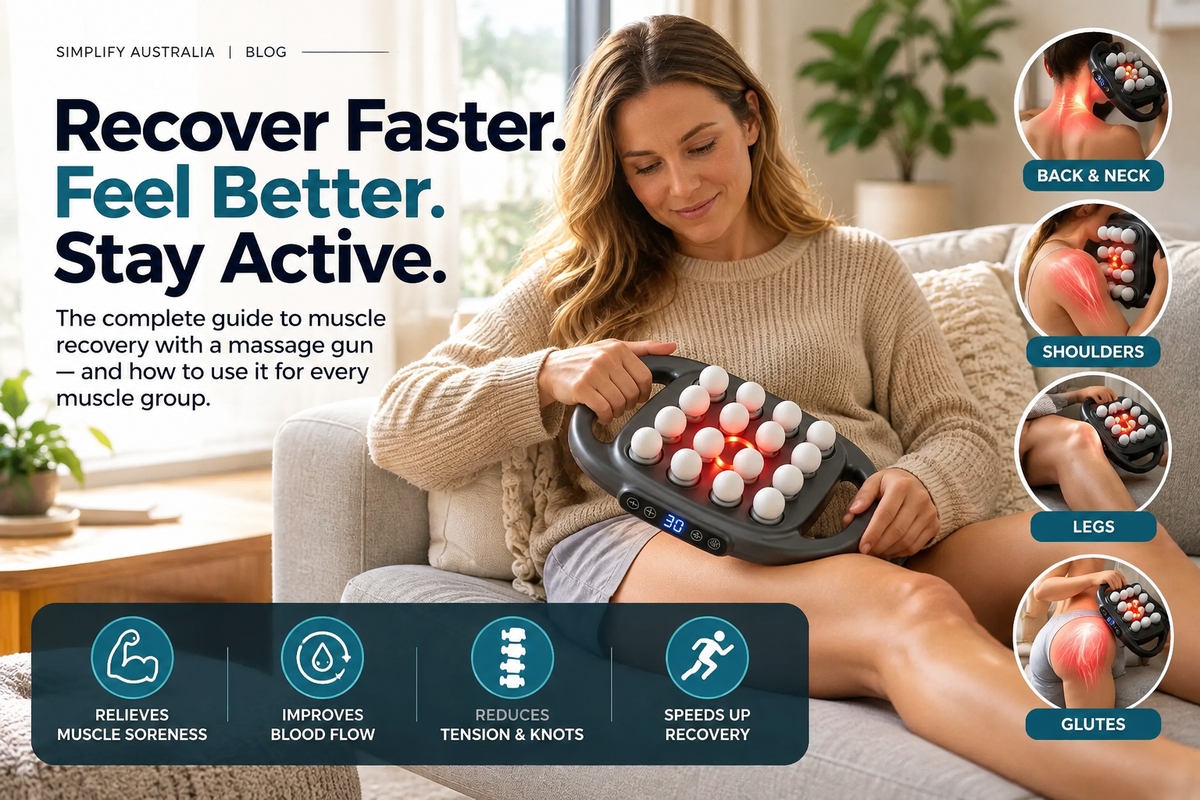
You pushed hard at the gym. Or you ran further than you planned. Or you spent Saturday in the garden digging, lifting, and hauling — and now every muscle from your shoulders to your calves is reminding you about it. The stiffness sets in a few hours later. The soreness peaks the next morning. And for the next two or three days, sitting down, standing up, and walking down stairs all feel like achievements.
This is delayed onset muscle soreness (DOMS), and it's a normal part of exercise and physical exertion. But here's what most people get wrong: recovery isn't just waiting for the pain to go away. How you recover — and how quickly — directly affects your performance, your consistency, and your risk of injury.
Muscle recovery at home used to mean a hot bath and hoping for the best. Now, the same percussive therapy and deep tissue techniques that professional athletes use are available in a handheld device you can use on the couch while watching TV. In this guide, we'll cover the science of muscle recovery, explain how a muscle massage gun works, walk through every muscle group and technique, and show you why the ProRelax 16-in-1 Deep Tissue Massager from Hive & Hush is the most versatile recovery tool you can own.
Why Muscle Recovery Matters More Than Most People Think
Most people focus on training — the workout itself. But recovery is where the actual progress happens. When you exercise, you create microscopic tears in muscle fibres. It's during recovery that these fibres repair and rebuild stronger. Skip or shortcut recovery, and you're limiting your gains, increasing injury risk, and extending the time before you can train effectively again.
According to the Australian Institute of Sport (AIS), recovery is a critical component of athletic performance, and strategies including massage, percussive therapy, and soft tissue work are used routinely across Australian high-performance sport programs. What was once reserved for elite athletes is now accessible to anyone with the right muscle recovery tools.
What Happens When You Don't Recover Properly
Accumulated fatigue. Training on muscles that haven't recovered leads to compounding fatigue — each session adds to the deficit rather than building on a fresh base. Performance declines, motivation drops, and overtraining becomes a real risk.
Increased injury risk. Tight, fatigued muscles don't respond well under load. Strains, pulls, and tears are significantly more likely when you train on muscles that are still recovering from the last session.
Reduced range of motion. Sore, tight muscles restrict movement. This forces compensation patterns — your body finds alternative ways to complete movements, loading joints and muscles that aren't designed for the task. Compensation is a direct path to injury.
Slower progress. Whether your goal is strength, endurance, flexibility, or body composition, recovery is the bottleneck. You can't train hard enough to outrun poor recovery — you can only train as hard as your recovery allows.
How Does a Massage Gun Work for Muscle Recovery?
A muscle massage gun — also called a percussive therapy device — delivers rapid, concentrated pulses of pressure deep into muscle tissue. Unlike a foam roller (which applies broad, surface-level pressure) or a manual massage (which relies on the therapist's hand strength and endurance), a massage gun drives targeted force directly into the muscle belly at a controlled depth and frequency.
Here's what percussive therapy does:
Increases Blood Flow
Each percussion pulse pushes blood into the targeted muscle tissue and draws waste products (including lactic acid and metabolic byproducts) out. Increased blood flow means more oxygen and nutrients reach the damaged fibres, accelerating the repair process. This is the fundamental mechanism behind massage for muscle recovery.
Breaks Up Adhesions and Knots
Muscle knots (myofascial trigger points) are localised areas of contracted, stuck muscle fibre. They restrict movement, cause referred pain, and limit performance. A massage gun for tight muscles delivers focused percussive force directly into these adhesions, breaking them up more effectively than stretching or foam rolling alone.
Reduces Muscle Tension
Percussion stimulates the Golgi tendon organs and muscle spindles — the nervous system sensors that regulate muscle tension. This stimulation triggers a neurological relaxation response, causing the muscle to release and lengthen. This is why a massage gun for sore muscles provides almost immediate relief from post-workout tightness.
Improves Range of Motion
By breaking up adhesions, reducing tension, and increasing blood flow, percussive therapy improves range of motion both acutely (immediately after use) and over time with consistent use. A deep tissue massage at home session before training can significantly improve mobility and warm-up effectiveness.
The ProRelax 16-in-1 Deep Tissue Massager delivers all of these benefits with 16 interchangeable heads designed for different muscle groups, angles, and intensities — making it the most versatile recovery massage gun we've ever stocked.

How to Use a Massage Gun on Every Muscle Group
One of the biggest advantages of the ProRelax 16-in-1 system is that different heads are designed for different body areas. Here's a muscle-by-muscle guide:
Legs: Quads, Hamstrings, and Calves
The legs are the most common target for post workout recovery — and the area where most people feel DOMS the hardest.
Quads (front of thigh): Use a large flat or ball head. Start at the knee and work slowly upward toward the hip. Spend extra time on any spots that feel particularly tight or tender. 60–90 seconds per quad.
Hamstrings (back of thigh): Same approach — large flat head, working from just above the knee upward to the glute fold. Hamstrings are often tighter than quads, so use a slightly lower speed setting and let the gun sit on trigger points for 10–15 seconds. A massage gun for legs is most effective when you don't rush.
Calves: Use a smaller round head. Work from the Achilles tendon area upward toward the back of the knee. Calves are dense muscles with deep trigger points — a percussive massager reaches them far more effectively than stretching alone.
Back: Upper, Mid, and Lower
Upper back and traps: Use a fork or dual-prong head that straddles the spine. Never place a massage gun directly on the spine itself — work the muscles on either side. Traps respond well to medium-speed percussion, 60 seconds per side.
Mid back: A massage gun for back muscles with a flat head works well across the mid-back. This area holds tension from desk work, poor posture, and heavy lifting. Work horizontally across the muscle fibres.
Lower back: Use a soft or cushioned head on the lowest speed setting. The lower back is sensitive, and the muscle layer is thinner than the upper back. Gentle, slow passes only — never aggressive percussion on the lumbar spine.
Shoulders and Neck
Deltoids and rotator cuff: A small round or bullet head provides targeted relief for shoulder tension and rotator cuff tightness. Work around the shoulder joint, not directly on it. 30–45 seconds per area.
Neck: Extreme caution here. Use only the softest head on the lowest speed. Work only on the muscular sides of the neck (upper traps and levator scapulae), never the front of the throat or directly on the cervical spine. If you have any neck conditions, consult a physiotherapist before using a massage gun on the neck.
Glutes
The glutes are large, deep muscles that respond exceptionally well to percussive therapy. Use a large ball or flat head on a medium-to-high speed setting. Work across the entire glute, spending extra time on the piriformis (deep in the centre of the glute) — a common source of hip and sciatic pain.
Arms: Biceps, Triceps, and Forearms
Use a small flat or round head. Arms have less muscle mass than legs, so reduce speed and pressure. Focus on the belly of each muscle — biceps, triceps, and forearm extensors. 30–45 seconds per muscle group.
Feet (Plantar Fascia)
Use a bullet or small round head on the sole of the foot. Roll slowly from heel to toe, pressing into the arch. This is particularly effective for plantar fasciitis, runner's foot, and general foot fatigue after a long day on your feet — especially if you also use a ComfortStep Anti-Fatigue Kitchen Mat for standing comfort prevention.

When to Use a Massage Gun: Before, During, and After Exercise
Before Exercise (Warm-Up Activation)
A 30–60 second percussive session on each target muscle group before training increases blood flow, activates the muscles, and improves range of motion. This is not a deep recovery session — it's a quick, light pass to prime the muscles. Use a low-to-medium speed setting.
During Exercise (Between Sets)
For advanced users, brief 15–20 second percussion between heavy sets can reduce inter-set tightness and maintain range of motion throughout the workout. Use on the working muscle group only, at a moderate speed.
After Exercise (Recovery)
This is the primary use case. A post workout muscle recovery session with a massage gun should happen within 1–2 hours of training for maximum benefit. Spend 60–90 seconds per major muscle group, focusing on areas that feel tight or sore. Use a medium-to-high speed setting with appropriate head attachments.
On Rest Days (Maintenance)
Even on non-training days, a light percussive session promotes blood flow, reduces residual tightness, and keeps muscles supple. This is particularly useful for muscle recovery after exercise when DOMS peaks 24–48 hours post-workout.
5 Common Muscle Recovery Mistakes
Mistake 1: Skipping Recovery Entirely
The "no pain, no gain" mindset leads many people to ignore recovery altogether. Training hard is only half the equation — muscle recovery is where the adaptation actually happens. Skipping it doesn't make you tougher; it makes you slower, tighter, and more injury-prone.
Mistake 2: Only Using Static Stretching
Static stretching after exercise has value, but it only addresses muscle length — not blood flow, adhesions, or deep tissue tension. Combining stretching with percussive therapy provides a more complete recovery protocol. A muscle massage gun reaches deeper tissue layers that stretching alone can't access.
Mistake 3: Using a Massage Gun Too Aggressively
More pressure and higher speed don't mean better recovery. Excessive force can bruise tissue, aggravate inflammation, and cause more damage than it resolves. Let the gun's percussion do the work — guide it, don't press it into the muscle. Start on a lower speed and increase only as needed.
Mistake 4: Ignoring Hydration and Nutrition
No amount of percussive therapy compensates for dehydration and poor nutrition. Muscles need water, protein, and micronutrients to repair. A massage gun enhances recovery — it doesn't replace the fundamentals.
Mistake 5: Using the Wrong Attachment
A bullet head designed for trigger points will be too intense on a broad muscle like the quad. A flat head designed for large surfaces won't reach deep enough on a calf knot. The ProRelax ships with 16 heads for a reason — matching the right attachment to the right muscle is critical for effective deep tissue massage at home.
Why 16 Heads Makes the ProRelax the Best Massage Gun for Recovery
Most massage guns ship with 4–6 attachment heads. The ProRelax 16-in-1 Deep Tissue Massager ships with 16 — and each one is designed for a specific purpose:
- Large flat heads — broad coverage for quads, hamstrings, glutes, and large muscle groups
- Small round heads — targeted work on arms, calves, and smaller muscle groups
- Bullet/cone heads — precision trigger point release for knots and adhesions
- Fork/U-shaped heads — spine-straddling work for the back and neck muscles
- Soft/cushioned heads — gentle work on sensitive areas like the lower back and neck
- Specialised heads — designed for specific body areas including feet, IT band, and forearms
This versatility makes the ProRelax effective as a massage gun for athletes, a massage gun for legs, a massage gun for back muscles, and a massage gun for tight muscles — all in one device. No other single tool in your home muscle recovery equipment collection covers as many use cases.
Who Needs a Deep Tissue Massager?
The ProRelax 16-in-1 Deep Tissue Massager is for anyone who uses their body and wants it to recover faster:
- Gym-goers and weightlifters who experience regular DOMS and need faster post workout recovery
- Runners and cyclists who deal with tight calves, hamstrings, and IT bands
- Weekend warriors who push hard on Saturday and need to function on Monday
- Office workers with chronic upper back, neck, and shoulder tension from desk work
- Tradies whose bodies take a beating from physical labour every day
- Older Australians managing joint stiffness, reduced mobility, and general muscle soreness
- Yoga and pilates practitioners looking to enhance flexibility and release deep-held tension
- Parents who carry kids, push prams, and bend constantly — accumulating tension without realising it
- Anyone who's spending money on regular massage appointments and wants a more cost-effective alternative at home

Browse Our Full Range of Home & Wellness Products
The ProRelax 16-in-1 Deep Tissue Massager is part of our growing wellness and home collection at Hive & Hush:
- ComfortStep Anti-Fatigue Kitchen Mat — cushioned standing comfort for the kitchen
- PillowPro Australian Made Contour Pillow — ergonomic cervical support for pain-free sleep
- ProCloud Australian Wool Pillow — natural wool for temperature-regulating comfort
- EarthEase Organic Grounding Sheet — sleep grounded with silver thread and organic cotton
- FastDry Drying Towel — ultra-fast drying microfibre towel for gym and bathroom
- ProChef Titanium Cutting Board — the safest, most hygienic cutting board you can own
- TurboClean 9-in-1 Cordless Spin Scrubber — clean bathrooms, tiles, and grout in minutes
👉 Browse Australia's Leading Home & Travel Products
👉 Visit the Hive & Hush Homepage
Ready to Recover Faster After Every Workout?
Stop waiting three days for the soreness to pass. Stop spending $80 a session on professional massage. The ProRelax 16-in-1 Deep Tissue Massager gives you professional-grade percussive therapy at home — 16 heads, multiple speed settings, and the power to target every muscle group in your body.
Shop the ProRelax 16-in-1 Deep Tissue Massager Now →
Or explore our full range at Hive & Hush.
Sources:
- Australian Institute of Sport (AIS) — Recovery strategies used in Australian high-performance sport, including massage and percussive therapy as routine recovery modalities.


Leave a comment
This site is protected by hCaptcha and the hCaptcha Privacy Policy and Terms of Service apply.