
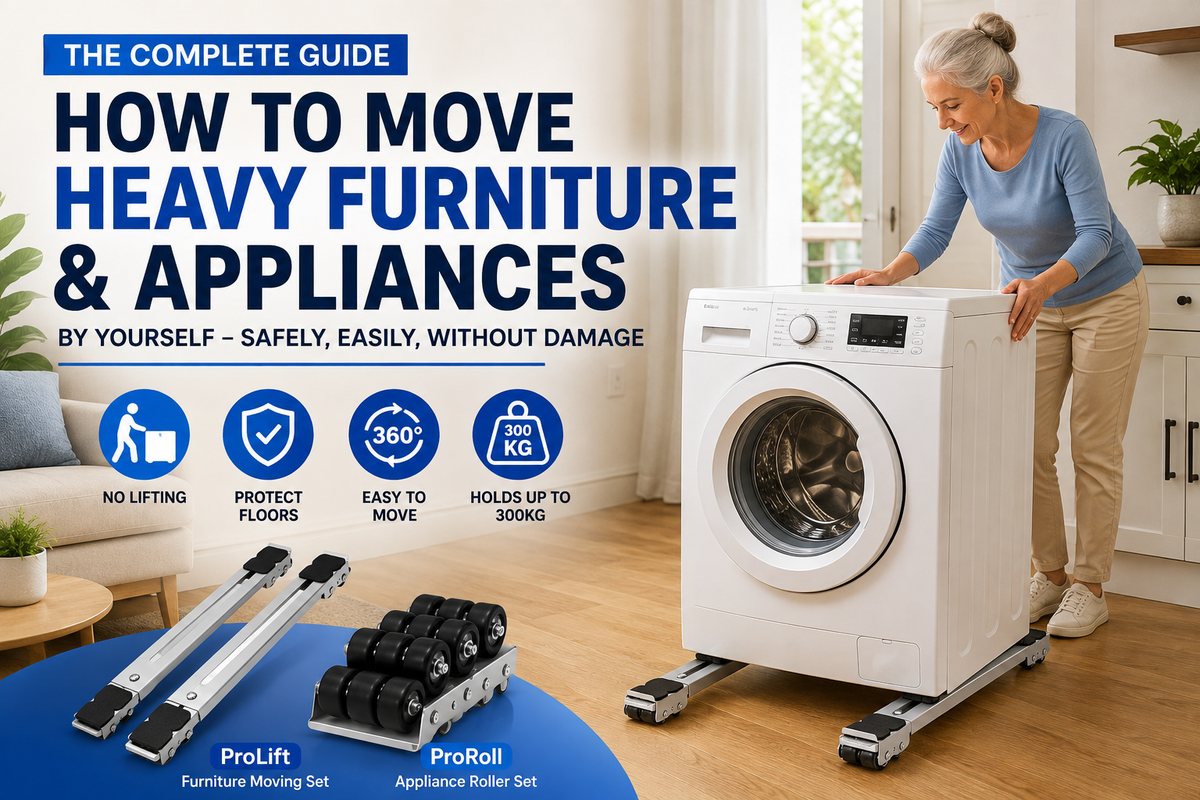
Moving day arrives and everything else is packed — but your 90kg washing machine and 150kg fridge are still sitting exactly where they were bolted in three years ago. Or maybe you're not moving house at all. Maybe you need to shift the washing machine to fix a leaking hose, swap the fridge to the other wall during a kitchen reno, or replace the flooring under your dryer.
Whatever the reason, the problem is the same: these appliances are brutally heavy, awkwardly shaped, and connected to plumbing or power that makes them feel permanently installed. Most people either call a removalist for a single appliance (expensive), recruit reluctant friends (risky), or try to drag it across the floor solo (a recipe for scratched tiles, herniated discs, and colourful language).
There's a better way. In this guide, we'll walk you through exactly how to move a washing machine, how to move a refrigerator, and every other heavy appliance in your home — safely, by yourself, without damage to the appliance or your floors. We'll compare every appliance moving tool available, explain what works for one-off moves versus permanent access, and show you why the ProRoll Appliance Roller Set from Simplify Australia has become the go-to solution for Australian households.
Why Moving Heavy Appliances Is More Dangerous Than You Think
Most people underestimate the risks of moving heavy appliances. A standard top-loader washing machine weighs 60–80kg. A front-loader with a concrete counterweight can weigh 90–110kg. A full-size fridge starts at 80kg and goes well past 150kg for French-door models. These aren't light items with convenient handles — they're heavy, top-heavy, and easy to lose control of.
According to Safe Work Australia, manual handling injuries — including those from lifting, pushing, and pulling heavy objects — account for a significant proportion of musculoskeletal injuries reported each year. Moving appliances at home carries the same risks as any workplace manual handling task, but without the training, the team, or the equipment.
The three most common injuries from moving appliances at home:
Back injuries. Lifting or tipping an 80kg+ appliance without proper technique puts enormous strain on the lumbar spine. A single awkward lift can cause disc bulges, muscle tears, or chronic pain that takes months to resolve.
Crushed feet and toes. Appliances that tip or slide unexpectedly can land on your feet. Steel-capped boots aren't standard issue for a Saturday afternoon fridge move.
Floor and wall damage. Dragging a washing machine across tiles leaves scratches. Bumping a fridge through a doorway dents plasterboard. Tipping a dryer onto its side can crack a tile. The repair costs often exceed the cost of proper appliance moving equipment.
Every Appliance Moving Method Compared
There are several ways to move heavy appliances. Here's how each method stacks up:
Method 1: Appliance Dolly (Upright Hand Truck)
An appliance dolly is a heavy-duty hand truck with a tall back, straps, and sometimes stair-climbing wheels. You tip the appliance backward onto the dolly's base plate, strap it in, and wheel it to the new position.
Best for: One-off moves across flat surfaces — house moves, deliveries, and repositioning.
Drawbacks: Requires tipping the appliance (risk of damage and injury), needs two people for very heavy items, can't navigate tight spaces easily, and needs to be stored when not in use. An appliance moving dolly is a professional tool — effective, but overkill for most household situations.
Method 2: Appliance Roller Set (Permanent or Temporary)
Appliance rollers are compact, wheeled platforms that sit under each corner or foot of the appliance. Once installed, the appliance can be rolled in any direction — forward, backward, sideways — with minimal effort, by one person.
Best for: Both one-off moves and ongoing access (cleaning, maintenance, renovations). Once installed, rollers stay under the appliance permanently.
Advantages: No tipping, no lifting, no strapping. One person can move a fully loaded fridge. The ProRoll Appliance Roller Set includes four roller bases with multi-directional castors, rated for heavy household appliances.
Method 3: Furniture Lifter + Rollers
A furniture lifter (lever tool) raises one corner of the appliance at a time, and a roller pad is slid underneath. This is the same method used in the ProLift Furniture Moving Set — and it pairs perfectly with the ProRoll for initial installation under very heavy appliances that are difficult to tilt manually.
Best for: Getting rollers under appliances that are too heavy to tilt by hand. The lifter provides mechanical leverage that eliminates manual lifting.
Method 4: Furniture Sliders
Flat pads placed under appliance feet to reduce friction. Budget-friendly but limited — they work for short slides on smooth floors but offer no steering control, no lifting capability, and struggle with very heavy items.
Best for: Light appliances on short, straight slides only.
Method 5: Brute Force (Dragging, Tipping, Walking)
No tools, no equipment — just pushing, pulling, rocking, and hoping for the best.
Best for: Nothing. This is how floors get scratched, backs get injured, and appliances get damaged. Always use the right appliance moving tools.
How to Move a Washing Machine by Yourself
Here's the step-by-step method for safely moving a washing machine solo:
Step 1: Disconnect Everything
Unplug the power cord. Turn off the hot and cold water taps. Disconnect the inlet hoses. Place a towel or bucket under the connections to catch residual water. If it's a front-loader, check the drain filter for trapped water and drain it.
Step 2: Secure the Drum (If Moving Long Distance)
If you're moving the washing machine to a new location (not just shifting it within the same room), install the transit bolts. These are the bolts that lock the drum in place during transport — they came with the machine when it was new. Running a washing machine without removing transit bolts at the destination can cause serious damage.
For a short shift within the same room, transit bolts aren't necessary.
Step 3: Get It Onto Rollers
This is where the right tool makes all the difference. You have two options:
Option A — Tilt and slide: Carefully tilt the machine backward (about 15 degrees), slide the front two ProRoll roller pads under the front feet, then tilt forward and slide the rear rollers under.
Option B — Use a furniture lifter: If the machine is too heavy to tilt manually (common with front-loaders), use the ProLift Furniture Moving Set lifter to raise each corner individually and slide a roller underneath. This method requires zero manual lifting.
Step 4: Roll Into Position
With all four rollers in place, push the washing machine to its new location. The multi-directional castors allow precise steering — even in tight laundry spaces. Move appliances without lifting — just push.
Step 5: Reconnect
Reconnect the inlet hoses, tighten connections, turn on taps (check for leaks), plug in, and remove transit bolts if installed. Run an empty rinse cycle to confirm everything works.

How to Move a Refrigerator by Yourself
Fridges present additional challenges — they're heavier than washing machines, often wider, and have temperature-sensitive contents.
Step 1: Empty and Defrost
Remove all food and shelving. If the fridge has a freezer with ice buildup, allow time to defrost — moving a fridge with ice inside adds unnecessary weight and risks water damage.
Step 2: Unplug and Disconnect
Unplug the power cord. Disconnect the water line if the fridge has a water/ice dispenser. Tape cords and lines to the back of the fridge so they don't drag.
Step 3: Protect the Floors
Plan your route and ensure the path is clear. For fridge moving rollers, the ProRoll Appliance Roller Set uses non-marking castors that are safe on tile, timber, laminate, and vinyl.
Step 4: Install Rollers
Use the tilt-and-slide method or the ProLift lifter to get roller pads under all four corners. A fridge moving tool that eliminates lifting is essential for anything over 100kg.
Step 5: Roll Into Position
Push the fridge to its new location. Steer carefully through doorways — measure beforehand to confirm clearance.
Step 6: Let It Settle Before Plugging In
After moving, leave the fridge standing upright for at least 4 hours before plugging it back in. This allows the compressor oil to settle — plugging in too soon can damage the compressor. This applies whether you moved it across the room or across the city.
Step 7: Consider Permanent Rollers
If you need regular access behind your fridge (for cleaning, leak checks, or maintenance), leave the ProRoll rollers installed permanently. Pull the fridge out and push it back any time — a refrigerator moving dolly is a one-off tool, but appliance rollers give you ongoing access forever.
How to Move Other Heavy Appliances
Dryer
Same method as a washing machine — disconnect, install rollers, roll. Dryers are lighter than washers (typically 40–60kg) and have no water connections, making them the easiest major appliance to move.
Oven or Range
Disconnect gas (call a licensed gasfitter) or unplug electric, pull away from the wall using rollers. Ovens are heavy but compact — rollers handle them easily. This is especially useful before and after kitchen renovations.
Dishwasher
Disconnect water supply and drain hose, slide out from under the benchtop using rollers. Dishwashers are often screwed to the underside of the bench — remove those screws first.
Chest Freezer
Empty contents, unplug, install rollers. Chest freezers in garages often sit on concrete — rollers work on concrete floors without issue.

6 Common Mistakes When Moving Heavy Appliances
Mistake 1: Dragging on Bare Floors
Never drag an appliance directly on the floor. The feet or base will scratch tiles, gouge timber, tear vinyl, and leave marks that cost hundreds to repair. Always lift onto rollers or sliders first.
Mistake 2: Tilting a Fridge Horizontally
Fridges should remain upright during moves. Laying a fridge on its side can cause compressor oil to flow into the cooling lines, potentially causing permanent damage. If you must tilt, keep it minimal and stand it upright for several hours before powering on.
Mistake 3: Forgetting Transit Bolts
If you're moving a washing machine any significant distance, install the transit bolts to lock the drum. Without them, the drum can swing and damage the internal suspension and shock absorbers during transport.
Mistake 4: Not Turning Off Water First
Disconnecting washing machine hoses without turning off the taps first results in an immediate flood. Taps off first, then disconnect.
Mistake 5: Moving Alone Without Tools
If you don't have an appliance mover tool, don't try to muscle a 120kg fridge by yourself. The risk of injury and damage is too high. A proper appliance moving kit like the ProRoll set eliminates the need for brute force entirely.
Mistake 6: Plugging the Fridge In Immediately After Moving
Always wait at least 4 hours (some manufacturers say 24) before powering on a fridge that has been moved or tilted. This prevents compressor damage.
Appliance Dolly vs. Appliance Rollers: Which Do You Need?
Here's the key difference:
An appliance dolly is a one-off moving tool. You use it to get the appliance from point A to point B, then store it. It requires tipping the appliance, strapping it, and often a second person. Best for removalists and long-distance moves.
Appliance rollers are a permanent or semi-permanent solution. Once installed, the appliance can be moved any time — for cleaning, maintenance, renovation, or repositioning — by one person, with one hand. No tipping, no strapping, no storage needed.
For most Australian households, a set of appliance rollers is the smarter investment. The ProRoll Appliance Roller Set serves as both a heavy appliance mover for the initial move and a permanent access solution for years afterward. A washing machine moving tool you install once and use forever.

Browse Our Full Range of Home Products
The ProRoll Appliance Roller Set works perfectly alongside our other home products:
- ProLift Furniture Moving Set — lever-lift heavy furniture and appliances without bending
- TurboClean 9-in-1 Cordless Spin Scrubber — clean bathrooms, tiles, and grout in minutes
- ProDust Ceiling Fan Cleaner — clean every fan blade without a ladder
- DustPro Blind Cleaner — clean both sides of every blind slat in one pass
- ProHook Stainless Steel Suction Hooks — damage-free hooks for bathrooms and kitchens
- ProCloud Australian Wool Pillow — temperature-regulating natural wool for better sleep
- EarthEase Organic Grounding Sheet — sleep grounded with silver thread and organic cotton
👉 Browse Australia's Leading Home & Travel Products
👉 Visit the Simplify Australia Homepage
Ready to Move Appliances the Smart Way?
Stop dragging. Stop tipping. Stop risking your back and your floors. The ProRoll Appliance Roller Set lets you move any heavy appliance — by yourself, without lifting — and gives you permanent easy access for years to come.
Shop the ProRoll Appliance Roller Set Now →
Or explore our full range of clever home products at Simplify Australia.
Sources:
- Safe Work Australia — Manual Handling — Data on musculoskeletal injuries from lifting and moving heavy objects in Australian homes and workplaces.

Leave a comment
This site is protected by hCaptcha and the hCaptcha Privacy Policy and Terms of Service apply.