
You've booked the flights. You've packed the bags. You've downloaded offline maps. You land in Tokyo, drag yourself to the hotel, plug your phone in to charge — and the plug doesn't fit the wall.
It's one of the most common (and most preventable) travel mistakes Australians make. And it's not surprising when you learn that there are 15 different plug types used around the world, according to the International Electrotechnical Commission. Australia uses Type I — the angled flat-pin plug that works in exactly seven countries. The other 188 countries on the planet use something different.
The question every Aussie traveller asks before a trip is simple: what adapter do I need? The answer depends entirely on where you're going — unless you carry one adapter that works everywhere.
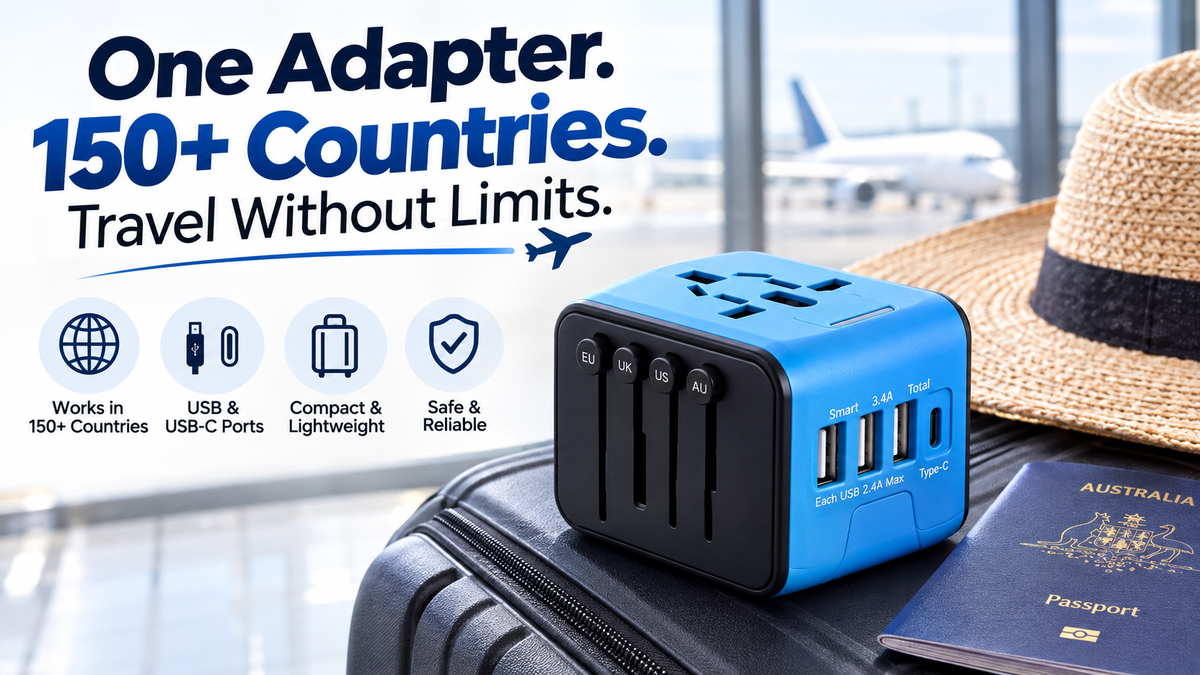
The Universal Travel Adapter from Simplify Australia works in over 150 countries with a single device. No guessing which plug type you need. No buying a different adapter for every destination. No arriving at your hotel with a dead phone and no way to charge it.
But before we get to the product, let's answer the question properly — because understanding international plug types will save you confusion on every trip for the rest of your life.
International Plug Types: A Quick Guide for Australians
The IEC (International Electrotechnical Commission) classifies plug types using letters A through O. Here's what you actually need to know as an Australian traveller:
Australia uses Type I — two angled flat pins in a V-shape, plus a grounding pin. This plug works in Australia, New Zealand, Papua New Guinea, Fiji, Tonga, and a handful of other Pacific nations. China and Argentina use a visually similar plug but with slightly different specifications.
That's it. Everywhere else uses a different plug type. Here's the breakdown for the destinations Australians visit most.
What Adapter Do I Need for Europe?
Europe primarily uses Type C (two round pins) and Type F (two round pins with grounding clips). Some countries add their own variations — France uses Type E, Italy uses Type L, and Switzerland uses Type J — but a standard European adapter handles most of them.
Countries using European-style plugs (Type C/E/F): France, Germany, Spain, Italy, Greece, Portugal, Netherlands, Austria, Sweden, Norway, Denmark, Finland, Belgium, Croatia, Czech Republic, Hungary, Poland, Turkey, and most of the rest of continental Europe.
Voltage: 220–240V at 50Hz — same as Australia, so your devices work fine with just an adapter (no voltage converter needed).
The takeaway: A travel adapter for Europe needs to accept an Australian Type I plug and output to Type C/F. Or just use a universal adapter and skip the guesswork entirely.

What Adapter Do I Need for the USA?
The United States uses Type A (two flat parallel pins) and Type B (two flat pins plus a grounding pin). These are completely different from Australian plugs and from European plugs.
Countries using US-style plugs (Type A/B): USA, Canada, Mexico, most of Central America, and parts of the Caribbean and South America.
Voltage: 120V at 60Hz — lower than Australia's 230V. Most modern phone chargers, laptop adapters, and camera chargers are dual-voltage (check the label for "100–240V input") and will work fine with just a plug adapter. Hair dryers, straighteners, and other heated appliances that are NOT dual-voltage may need a voltage converter or could be damaged.
The takeaway: An Australia to USA plug adapter converts your Type I plug to Type A/B. Always check your appliance's voltage rating before plugging in.
What Adapter Do I Need for Japan?
Japan uses Type A (same physical plug as the USA) but runs on 100V at 50/60Hz — the lowest voltage of any developed country.
The catch: While the plug shape is the same as the US, the lower voltage means some appliances may run slower or less effectively. Phone chargers and laptops are almost always fine (dual-voltage). Hair dryers and straighteners may struggle or need a converter.
The takeaway: An Australia to Japan plug adapter is the same as a USA adapter (Type A). Your phone and laptop will work perfectly. Check heated appliances before plugging in.

What Adapter Do I Need for the UK?
The United Kingdom uses Type G — three rectangular pins in a triangular arrangement. It's one of the most distinctive plug types in the world and is completely incompatible with both Australian and European plugs.
Countries using UK-style plugs (Type G): United Kingdom, Ireland, Hong Kong, Singapore, Malaysia, Malta, Cyprus, and several Middle Eastern and African countries including UAE, Qatar, Kenya, and Nigeria.
Voltage: 230V at 50Hz — virtually identical to Australia. No voltage issues at all.
The takeaway: An Australia to UK plug adapter converts your Type I to Type G. Voltage compatibility is perfect, so all your devices work as normal.
What Adapter Do I Need for Bali and Southeast Asia?
This is where it gets messy. Southeast Asian countries use a mix of plug types, and some countries use multiple types depending on the building:
Indonesia (Bali): Type C and Type F (European-style round pins). Some older hotels may also have Type G (UK-style).
Thailand: Type A, B, C, and O. Yes, four different plug types. Newer buildings use Type O, but older ones can have anything.
Vietnam: Type A, C, and G. A mix of US, European, and UK plugs.
Singapore: Type G (UK-style).
Malaysia: Type G (UK-style).
The takeaway: Southeast Asia is the single strongest argument for carrying a universal adapter instead of destination-specific ones. You genuinely cannot predict which plug type you'll encounter, even within the same country.

The Complete Plug Type Reference: Top 30 Destinations for Aussie Travellers
Here's a quick-reference table for the destinations Australians visit most:
| Destination | Plug Type(s) | Voltage | Adapter Needed? |
|---|---|---|---|
| New Zealand | Type I | 230V | ❌ No — same as Australia |
| Fiji | Type I | 240V | ❌ No — same as Australia |
| Bali (Indonesia) | Type C, F | 230V | ✅ Yes |
| Thailand | Type A, B, C, O | 220V | ✅ Yes |
| Vietnam | Type A, C, G | 220V | ✅ Yes |
| Singapore | Type G | 230V | ✅ Yes |
| Malaysia | Type G | 240V | ✅ Yes |
| Japan | Type A | 100V | ✅ Yes (check voltage) |
| South Korea | Type C, F | 220V | ✅ Yes |
| China | Type A, C, I | 220V | ⚠️ Sometimes |
| India | Type C, D, M | 230V | ✅ Yes |
| UAE (Dubai) | Type G | 230V | ✅ Yes |
| France | Type C, E | 230V | ✅ Yes |
| Italy | Type C, F, L | 230V | ✅ Yes |
| Spain | Type C, F | 230V | ✅ Yes |
| Germany | Type C, F | 230V | ✅ Yes |
| Greece | Type C, F | 230V | ✅ Yes |
| Croatia | Type C, F | 230V | ✅ Yes |
| United Kingdom | Type G | 230V | ✅ Yes |
| Ireland | Type G | 230V | ✅ Yes |
| Portugal | Type C, F | 230V | ✅ Yes |
| Netherlands | Type C, F | 230V | ✅ Yes |
| Turkey | Type C, F | 230V | ✅ Yes |
| USA | Type A, B | 120V | ✅ Yes (check voltage) |
| Canada | Type A, B | 120V | ✅ Yes (check voltage) |
| Mexico | Type A, B | 127V | ✅ Yes (check voltage) |
| Hawaii (USA) | Type A, B | 120V | ✅ Yes (check voltage) |
| South Africa | Type C, D, M, N | 230V | ✅ Yes |
| Brazil | Type C, N | 127/220V | ✅ Yes (check voltage) |
| Argentina | Type C, I | 220V | ⚠️ Sometimes |
The pattern is clear: almost everywhere outside Australia and New Zealand requires an adapter. A universal adapter covers every single destination on this list — and the 120+ countries not on it.
Why a Universal Travel Adapter Beats Destination-Specific Ones
You could buy a separate Australia to Europe plug adapter, an Australia to USA plug adapter, an Australia to Japan plug adapter, and an Australia to UK plug adapter. That's four devices, four things to pack, four things to lose, and four things that are useless outside their specific region.
Or you could buy one universal adapter that handles all of them.
The Universal Travel Adapter from Simplify Australia works in over 150 countries with a single device. Slide out the appropriate pins for your destination, plug in your device, and you're charging. Switch countries on the same trip? Just slide the pins to a different configuration. No repacking, no swapping devices, no confusion.
It handles multiple devices simultaneously, it's compact enough for carry-on luggage, and it eliminates the entire "which adapter do I need" question permanently.
Adapter vs. Converter: What's the Difference?
This trips up a lot of travellers, so let's clarify:
A travel adapter changes the shape of the plug so it fits a foreign socket. It does NOT change the voltage. If Australia's 230V goes into the adapter, 230V comes out the other side.
A voltage converter changes the electrical voltage — for example, from Australia's 230V down to the USA's 120V, or up from Japan's 100V.
The good news: Most modern electronics — phones, tablets, laptops, cameras, e-readers, electric toothbrushes — have built-in dual-voltage capability. Check the small print on your charger. If it says "Input: 100–240V," you only need an adapter, not a converter. The device handles the voltage difference internally.
The exception: Single-voltage appliances like hair dryers, hair straighteners, curling irons, and some older electric shavers are often rated for 230V only. Plugging a 230V-only appliance into a 120V socket (USA, Japan, Mexico) won't damage it, but it will run weakly or not at all. Plugging a 120V appliance into a 230V socket, however, can fry it instantly.
Rule of thumb: If it heats up or has a motor, check the voltage label. If it charges via USB or has a power brick, it's almost certainly dual-voltage and just needs an adapter.
Common Travel Adapter Mistakes to Avoid
Assuming all of Europe uses the same plug. Most of Europe uses Type C/F, but the UK uses Type G, Switzerland uses Type J, and Italy sometimes uses Type L. A universal adapter handles all of them without thinking.
Not checking voltage before plugging in heated appliances. Your phone charger is fine everywhere. Your hair straightener might not be. Always check the label for "100–240V" before plugging into a foreign socket.
Buying destination-specific adapters for a multi-country trip. If your trip covers three or more countries, a universal adapter is cheaper, lighter, and simpler than buying three separate adapters.
Packing the adapter in checked luggage. You'll need to charge your phone the moment you land. Keep the adapter in your carry-on — always.
Forgetting to pack one at all. This is the most common mistake. Airport adapters are overpriced and often low quality. Buy one before you leave and keep it permanently in your travel kit.
Using a cheap adapter that doesn't handle multiple devices. Budget adapters often have a single outlet and no USB ports. If you're charging a phone, laptop, and camera simultaneously, choose an adapter that handles multiple connections.
Pair It With These Travel Essentials
The Universal Travel Adapter works perfectly alongside these products from the Simplify Australia travel range:
- Travel Gadget & Accessory Organiser — Store your adapter alongside all your cables, chargers, and earbuds in one organised case.
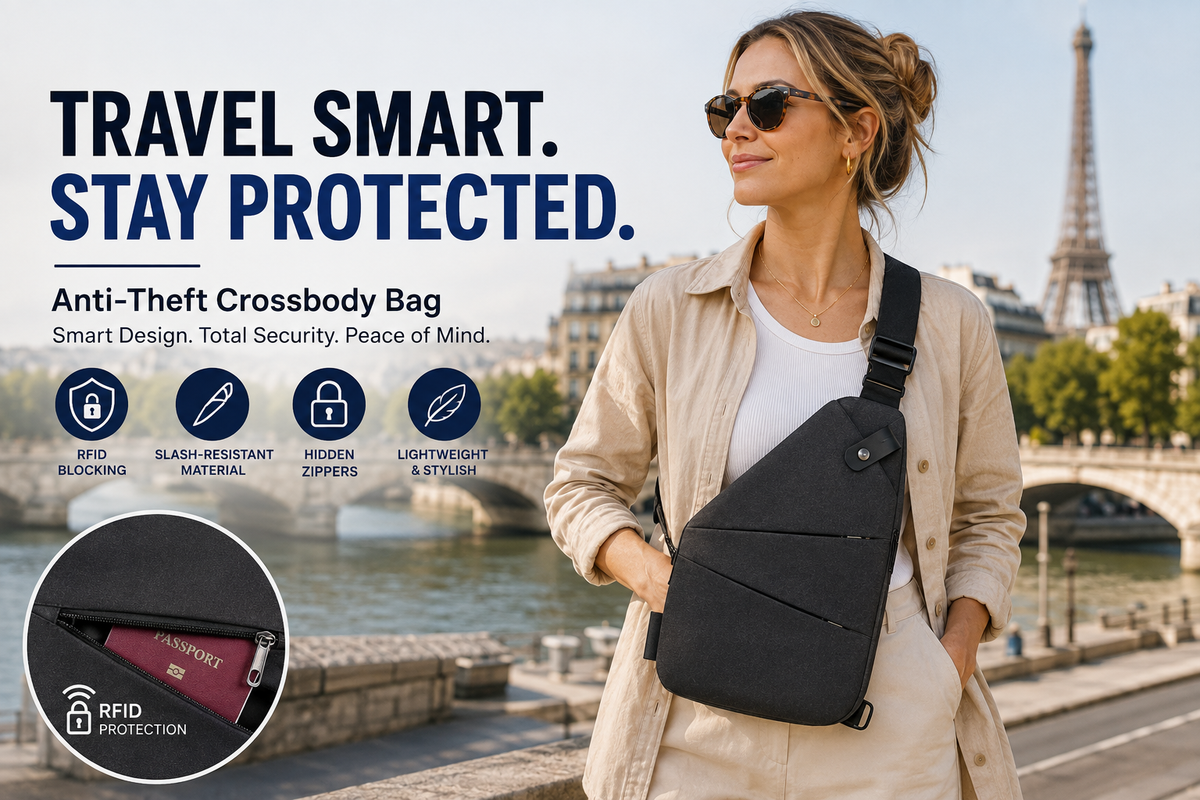
- Anti-Theft Crossbody Charging Bag — Charge your phone on the go during the day, then use the adapter to recharge the bag's power bank at night.
- 9-in-1 Travel Gadget Accessory Kit — Bundle your adapter with a complete travel tech kit for maximum preparedness.
- 3-in-1 Pocket Travel Fan — Your fan charges via USB, and your adapter makes sure you can charge it in any country.
- Digital Luggage Scale — Round out your essential travel gadget kit with a scale that saves you from excess baggage fees.

Frequently Asked Questions
Do I need a travel adapter for New Zealand? No. New Zealand uses the same Type I plug as Australia at the same voltage. Your devices plug in directly.
Do I need a travel adapter for Bali? Yes. Bali uses Type C and Type F plugs (European-style round pins). Your Australian plug won't fit without an adapter.
Will my phone charger work overseas with just an adapter? Almost certainly yes. Check your charger — if it says "Input: 100–240V," it's dual-voltage and only needs an adapter to change the plug shape. No voltage converter required.
Can I use a universal adapter permanently — like at home? It's designed for travel use. For permanent use, a dedicated power board or wall adapter is more appropriate and safer for long-term continuous load.
What's the difference between a travel adapter and a power board? A travel adapter changes the plug shape for foreign sockets. A power board (or power strip) provides multiple outlets from one socket. Some universal adapters include USB ports, giving you both functions in one device.
Is the adapter safe to use with expensive electronics? Yes. A quality universal adapter is designed to safely handle phones, laptops, cameras, and tablets. Always verify your appliance's voltage compatibility before plugging in.
Ready to Charge Anywhere in the World?
The Universal Travel Adapter is available now from Simplify Australia with fast shipping Australia-wide. One device, 150+ countries, and the end of "which plug do I need?" forever.
Browse it alongside our full range of travel essentials in the Australia's Leading Travel Products collection.
👉 Shop the Universal Travel Adapter Now
15 different plug types. 150+ countries. One adapter. Stop Googling "what adapter do I need for [country]" and start travelling with the only adapter you'll ever need.
Want to see more? Head to the Simplify Australia homepage to explore our full range of travel, home, and lifestyle essentials.
Happy travels! ✈️

Leave a comment
This site is protected by hCaptcha and the hCaptcha Privacy Policy and Terms of Service apply.