
Packing for a holiday should be exciting. But somehow, it often turns into sitting on your suitcase, trying to force the zip closed while wondering how you managed to accumulate so much stuff.
Whether you're heading overseas, taking a family holiday, planning a weekend getaway or travelling around Australia, knowing how to pack a suitcase efficiently can make the entire trip easier. The goal isn't necessarily to pack less. It's to pack smarter.
The right packing techniques can help you make better use of your luggage space, keep your belongings organised and avoid arriving at your destination with a suitcase full of wrinkled clothes.

Here are 10 simple ways to pack your suitcase like a pro.
1. Start With a Packing List
Before you even open your suitcase, make a list.
It sounds simple, but one of the easiest ways to overpack is to start throwing things into your luggage without deciding what you actually need first.
Think about:
- How many days you'll be away
- The weather at your destination
- Planned activities
- Whether you'll have access to laundry
- How many pairs of shoes you realistically need
- Any special occasions
- Essential toiletries and medication
- Electronics and chargers
Try planning outfits rather than packing individual items. Instead of thinking, "I'll take six tops just in case," think about how many complete outfits you'll actually wear.
A good rule is to choose versatile pieces that can be mixed and matched.
If you're going away for a week, you don't necessarily need seven completely different outfits. A few interchangeable tops, bottoms and layers can give you plenty of options without filling your entire suitcase.
And remember: if you're travelling somewhere with shops and you're likely to buy clothing during your trip, leave a little room for the journey home.
2. Choose the Right Suitcase and Don't Fill Every Inch
A larger suitcase doesn't always mean a better packing experience.
In fact, having too much space can encourage you to pack things you don't need. Instead, choose luggage that suits the length and type of your trip.
For a short getaway, a compact suitcase or Lightweight Foldable Travel Bag can be useful when you want something easy to store and carry.
For longer trips, focus less on simply having a bigger suitcase and more on making the space inside it work harder.
That's where organisation becomes important.
The aim is to create sections inside your luggage rather than having one giant pile of clothes.
3. Use Compression Packing Cubes
If you've ever opened your suitcase halfway through a trip and discovered that everything has somehow become one giant pile, you'll understand why packing cubes are so useful.
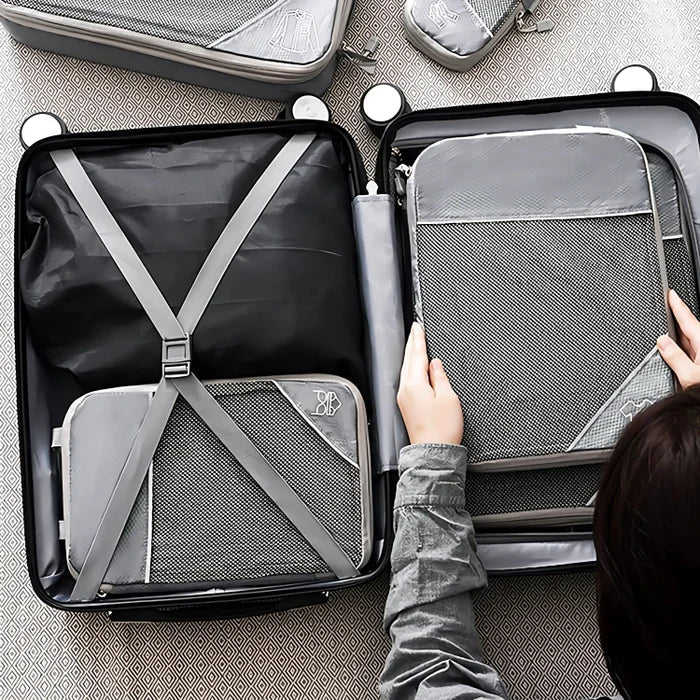
Compression Packing Cubes help separate your belongings into manageable sections while compressing clothing to make better use of your luggage space.
You can organise them by:
- Clothing type
- Outfit
- Family member
- Destination
- Activity
For example, one cube could hold tops, another underwear and socks, and another sleepwear.
Travelling with children? Give each family member their own cube. This makes it much easier to find everyone's clothes without emptying the entire suitcase onto the hotel bed.
Simplify Australia's Compression Packing Cubes are designed specifically for space-saving travel and can help you fit more into your suitcase while keeping everything organised.
The biggest benefit isn't just saving space. It's being able to find what you need without creating a suitcase disaster every morning.
4. Roll Your Clothes Instead of Folding Everything
There's a long-running debate among travellers: should you roll or fold your clothes?
For many casual clothing items, rolling is an easy way to make better use of your luggage.
T-shirts, shorts, leggings, pyjamas and lightweight tops can usually be rolled tightly and placed inside your packing cubes.
Rolling also makes it easier to see what you've packed instead of having to lift several folded layers to find one shirt.
For structured clothing, jackets or delicate pieces, folding may still be the better option.
The trick is not to follow one packing method for everything. Use the method that works best for each item.
A useful combination is:
Roll smaller, casual clothing. Fold structured or delicate pieces. Compress bulky items separately.
That gives you a much more efficient suitcase overall.
5. Use Vacuum Bags for Bulky Clothing
Packing cubes are excellent for everyday clothing, but what about bulky items?
Think winter jackets, jumpers, coats and other thick clothing. These can take up a surprising amount of room.
That's where Compression Vacuum Packing Bags can help.
They remove excess air from bulky clothing, reducing the amount of space those items take up in your luggage. Simplify Australia specifically positions these bags as a space-saving option for travellers dealing with bulky items.
They're particularly useful if you're travelling between different climates.
For example, you might start your trip somewhere warm and finish somewhere much colder. Rather than allowing a thick jacket to take up a huge section of your suitcase for the entire journey, you can compress it when you don't need it.
Just remember that reducing the volume of an item doesn't necessarily reduce its weight. If you're close to your airline's baggage limit, you'll still need to keep an eye on the total weight.
6. Make Your Shoes Work Harder
Shoes are one of the biggest space-wasters in a suitcase.
They're bulky, awkwardly shaped and often heavier than you realise.
Before packing multiple pairs, ask yourself whether you'll actually wear each one.
For most trips, you can usually get away with:
- One comfortable everyday pair
- One nicer option if needed
- Thongs or sandals for warm destinations
Wear your bulkiest shoes while travelling rather than packing them.
You can also use the empty space inside shoes for small items such as socks, belts or accessories.
Just place those items inside a clean bag first.
It may seem like a small trick, but those little pockets of unused space add up.
7. Keep Heavy Items Near the Bottom
Where you put items inside your suitcase can affect how easy it is to carry.
When packing a suitcase with wheels, place heavier items closer to the wheel side and lighter items towards the top. This can help distribute the weight more effectively and make the suitcase easier to manoeuvre.
Heavy shoes, toiletry bags and other dense items should generally sit low and towards the centre rather than being scattered randomly throughout the case.
Your packing cubes can also help distribute weight evenly.
And don't forget your luggage itself.
A suitcase that is already heavy before you've packed anything gives you less room to work with when you're trying to stay under an airline's baggage limit.
8. Weigh Your Suitcase Before You Leave
This is one of the easiest ways to avoid an unpleasant airport surprise.
You've carefully packed everything, zipped up your suitcase and arrived at the airport feeling organised.
Then the check-in scale says your bag is overweight.
Suddenly you're opening your suitcase in front of everyone and trying to decide which jumper you're prepared to sacrifice.
A Digital Luggage Scale can help you avoid that situation.
Weigh your suitcase before leaving home, particularly if you're travelling with checked luggage.
It's also worth leaving yourself a little breathing room rather than packing right up to the airline's maximum limit.
Why?
Because your luggage may gain weight during the trip.
A few souvenirs, an extra pair of shoes or a bottle of something you bought while away can quickly push you over the limit.
Simplify Australia's current travel collection includes a compact Digital Luggage Scale designed to help travellers check their luggage weight before heading to the airport.
9. Keep Your Essentials in Your Carry-On
If you're checking a suitcase, don't put everything you need in it.
Your carry-on should contain the essentials you'll need during the journey and anything that would be difficult or expensive to replace.
Consider keeping these with you:
- Passport and travel documents
- Wallet and cards
- Phone
- Chargers
- Essential medication
- Important valuables
- A change of clothes
- Basic toiletries
- Travel accessories
- Anything you absolutely need at your destination
This is particularly important if you're flying somewhere with a long journey or a connection.
A delayed or misplaced checked bag is frustrating enough. Having your essential items with you makes the situation much easier to manage.
A 9-in-1 Travel Gadget Accessory Kit can also help keep smaller travel accessories together instead of letting chargers and other essentials disappear into the bottom of your bag.
Simplify Australia's travel range includes a variety of compact organisers and travel accessories designed to make packing and organisation easier.
10. Leave Some Space for the Trip Home
This is the packing mistake that catches people out most often.
You pack your suitcase perfectly for the trip there.
Everything fits.
Then you buy a few things.
Suddenly, your suitcase has somehow become 20% smaller.
If you know you're likely to shop while travelling, don't pack your suitcase completely full before you leave.
Leave some empty space or take a lightweight spare bag that can be used for additional items.
A Lightweight Foldable Travel Bag can be a handy option for travellers who want an additional lightweight bag without adding another bulky piece of luggage to their trip.
The key is to plan for the return journey, not just the departure.
A Simple Suitcase Packing Order
Not sure where everything should actually go?
Try this simple system.
Bottom layer
Start with heavier or less frequently accessed items, such as shoes and bulkier clothing.
Middle layer
Add your packing cubes with everyday clothing.
Top layer
Place lighter items and anything you'll want to access quickly.
Separate compartments
Keep toiletries, electronics, documents and other smaller items in their own organisers.
Carry-on
Keep your passport, valuables, electronics, essential medication and important travel documents with you.
This system means you don't have to completely unpack your suitcase every time you need something.
Common Packing Mistakes to Avoid
Even experienced travellers can fall into a few common traps.
Packing for every possible scenario
It's tempting to pack something "just in case", but a suitcase full of things you never use is still taking up valuable space.
Taking too many shoes
Shoes are bulky. Be realistic about how many pairs you actually need.
Ignoring the weather
Check the forecast before you pack and think about the climate across your entire trip.
Forgetting baggage weight
A suitcase that fits perfectly can still be too heavy.
Packing without organisation
If everything is loose, finding anything later becomes much harder.
Using all your luggage space
Leave room for the return trip, especially if you're planning to shop.
Your Simple Packing Checklist
Before you zip up your suitcase, ask yourself:
- Have I packed only what I'll realistically use?
- Can my clothes be mixed and matched?
- Have I used packing cubes?
- Can bulky items be compressed?
- Have I limited my shoes?
- Are my important documents in my carry-on?
- Have I separated my electronics and chargers?
- Have I weighed my suitcase?
- Have I left room for anything I might buy?
- Can I easily find what I need without unpacking everything?
If you've answered yes, you're already packing more efficiently than most travellers.
Make Your Next Trip Easier With Smart Travel Accessories
Packing well isn't about squeezing every possible item into your suitcase. It's about making better use of the space you already have.
A few simple changes — rolling suitable clothes, using compression organisers, separating your belongings and checking your luggage weight — can make a surprisingly big difference.
Simplify Australia's travel range includes practical accessories designed to make travel more organised, comfortable and convenient, from Compression Packing Cubes and Compression Vacuum Packing Bags to a Digital Luggage Scale and Lightweight Foldable Travel Bag.
Whether you're heading off for a weekend, taking the family overseas or preparing for a longer adventure, the right travel accessories can help you spend less time wrestling with your suitcase and more time enjoying the trip.
Ready to pack smarter? Explore Simplify Australia's Leading Travel Products and make your next journey a little easier.
Frequently Asked Questions
What is the best way to pack a suitcase to save space?
Use a combination of rolling clothes, compression packing cubes and vacuum packing bags for bulky items. Organising your luggage into sections also helps you make better use of available space.
Do packing cubes actually save space?
Compression packing cubes can help compress clothing and organise your suitcase more efficiently. They're particularly useful when you have several types of clothing or are packing for multiple people.
Is it better to roll or fold clothes when packing?
Rolling works well for many lightweight and casual clothing items, while folding is generally better for structured or delicate garments. Using a combination of both methods is often the most practical approach.
How do I avoid overweight luggage?
Weigh your suitcase before leaving for the airport using a digital luggage scale. It's also a good idea to leave some weight capacity available for souvenirs and other items you may purchase during your trip.
How can I pack bulky clothes in a small suitcase?
Compression vacuum packing bags can help reduce the volume of bulky items such as jackets, jumpers and other thick clothing, giving you more usable suitcase space.
What should I put in my carry-on?
Keep important travel documents, valuables, medication, electronics, chargers and anything you may need during the journey in your carry-on rather than checked luggage.
How much empty space should I leave in my suitcase?
There's no fixed amount, but leaving some spare room is sensible if you're likely to shop during your trip. You should also leave some weight capacity rather than packing right up to the airline's limit.

Leave a comment
This site is protected by hCaptcha and the hCaptcha Privacy Policy and Terms of Service apply.