
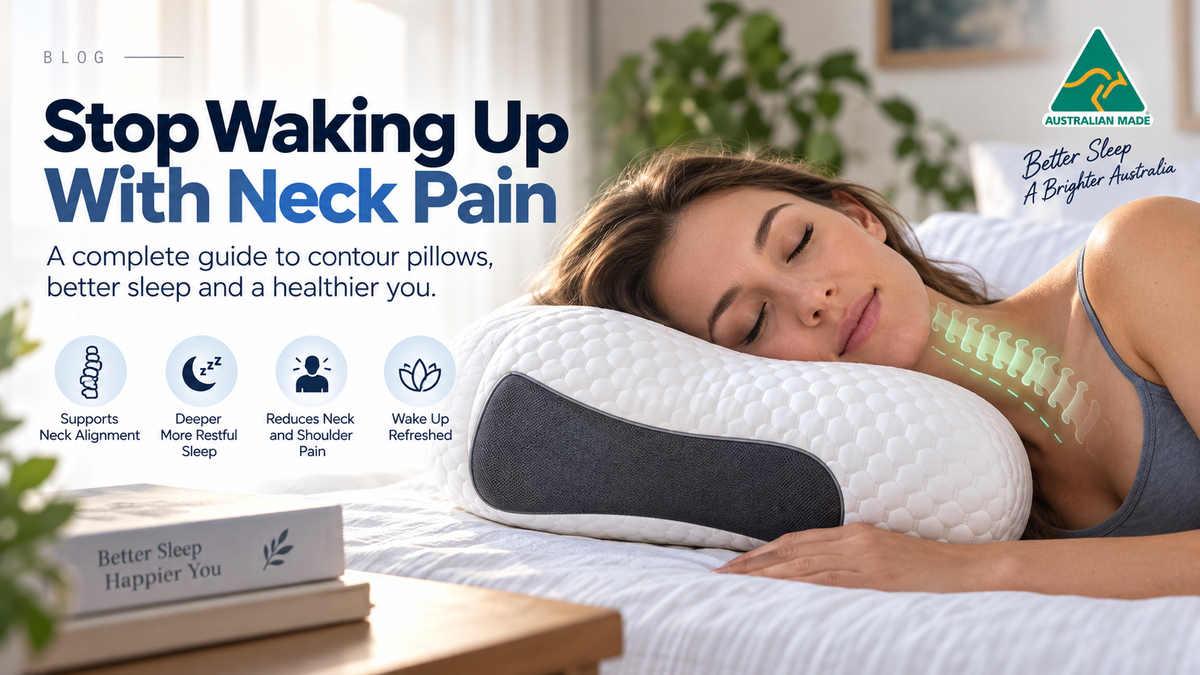
If you wake up most mornings with a stiff neck, sore shoulders, or a headache that fades after your first coffee, your pillow is probably the problem — not your mattress, not your sleep position, and not your age.
A flat, shapeless pillow doesn't support the natural curve of your cervical spine. When your head sinks too low (pillow too flat) or tilts too high (pillow too thick), your neck spends 6–8 hours in a misaligned position. Over time, this leads to chronic stiffness, tension headaches, nerve compression, and disrupted sleep.
The fix isn't just a "better" pillow — it's a differently shaped pillow. A contour pillow is ergonomically moulded with raised edges and a central cradle that supports your head and neck in the exact position they need to be in for neutral spinal alignment. It's not a luxury upgrade — it's the way pillows should have been designed from the start.
In this guide, we'll explain exactly how a cervical pillow works, why shape matters more than fill material, which sleeping positions benefit most, and why the PillowPro Australian Made Contour Pillow from Simplify Australia is one of the most effective sleep upgrades we've ever carried.
Why Your Current Pillow Is Causing Neck Pain
Most pillows sold in Australia are rectangular, uniformly filled, and designed around one principle: softness. They feel comfortable when you first lie down, but they provide almost zero structural support for your cervical spine.
Here's what happens biomechanically:
With a Flat or Shapeless Pillow
Your head sinks into the fill, your neck bends downward (for side sleepers) or hyperextends backward (for back sleepers), and the muscles along your neck and shoulders spend all night compensating for the misalignment. You wake up with stiffness, soreness, and reduced range of motion — not because you "slept wrong," but because your pillow held you in the wrong position for 8 hours.
With a Pillow That's Too High
An overstuffed pillow pushes your head forward and upward, creating a chin-to-chest angle that compresses the cervical vertebrae and strains the muscles at the base of the skull. This is a common cause of tension headaches and upper back pain.
With the Right Contour Pillow
A neck support pillow with a contoured shape cradles the natural lordotic curve of your cervical spine. The raised edges support the neck, the central depression holds the head, and the result is neutral alignment — your spine forms a straight, natural line from skull to tailbone. Muscles relax instead of compensating, and you wake up without stiffness.
According to the Australian Physiotherapy Association, pillow selection is one of the most frequently discussed topics in clinical practice, and physiotherapists routinely recommend contoured or cervical pillows for patients experiencing neck pain, headaches, and postural dysfunction related to sleep.

How Does a Contour Pillow Work?
A contour pillow — also called a cervical pillow, ergonomic pillow, or orthopedic pillow — has a sculpted shape with two key features:
The Cervical Roll (Raised Edges)
The front and back edges of the pillow are raised higher than the centre. These rolls sit under your neck, filling the natural gap between your head and shoulders. This is the feature that provides cervical support — the raised edge cradles the curve of your neck and prevents it from bending or hyperextending during sleep.
Most contour pillows have two different roll heights — one higher, one lower — so you can choose which side to sleep on based on your body size and sleeping position.
The Head Cradle (Central Depression)
The centre of the pillow dips lower than the edges, creating a shallow bowl shape. Your head rests in this depression, gently cradled in a neutral position. The cradle prevents your head from rolling side to side and keeps it aligned with your spine.
The Memory Foam Base
The best contour memory foam pillows are made from viscoelastic memory foam, which responds to heat and pressure to conform to the exact shape of your head and neck. Unlike polyester fill (which compresses unevenly) or feather fill (which shifts and bunches), memory foam provides consistent, responsive support that adapts to your anatomy.
The PillowPro Australian Made Contour Pillow uses high-density memory foam sculpted into a dual-height contour profile — engineered for proper cervical alignment across all sleeping positions.
Which Sleeping Position Benefits Most From a Contour Pillow?
Side Sleepers
A side sleeper pillow needs to fill the gap between your shoulder and the side of your head — keeping your neck straight, not angled downward or upward. This gap varies by person (broader shoulders = bigger gap), which is why the PillowPro's dual-height rolls are so useful: choose the higher roll for broader frames, the lower roll for smaller frames.
Side sleeping is the most common position in Australia, and it's also the position most affected by pillow choice. A flat pillow lets the head drop toward the mattress, compressing the shoulder-side neck muscles and misaligning the spine. A pillow for side sleepers with a proper contour prevents this entirely.
Back Sleepers
A back sleeper pillow needs to support the natural inward curve of the cervical spine without pushing the head too far forward. The contour pillow's central cradle holds the head in a neutral position, while the cervical roll fills the space under the neck curve. The result is a straight line from the back of the skull through the spine.
Back sleepers who switch from a flat pillow to a contour neck pillow often notice immediate improvement in morning stiffness and breathing comfort — a properly aligned airway reduces snoring and mild sleep-disordered breathing.
Combination Sleepers
If you switch between side and back sleeping throughout the night, a contour pillow still works. The dual-height design means you can orient the pillow with the appropriate roll height depending on how you tend to fall asleep, and the memory foam conforms as you shift positions.
Stomach Sleepers
Stomach sleeping is generally the least recommended position for spinal health because it forces neck rotation. While a contour pillow can be used for stomach sleeping (using the lower roll), most physiotherapists and sleep specialists recommend transitioning toward side or back sleeping for long-term neck health. A posture pillow can assist this transition by making side and back positions more comfortable.
Contour Pillow vs. Standard Pillow vs. Cervical Roll: What's the Difference?
Standard Flat Pillow
A traditional rectangular pillow with uniform fill — polyester, feather, down, or microfibre. No structural support for the neck. Comfort comes from softness, not alignment. The fill compresses over time, losing height and whatever minimal support it offered. Needs replacing every 1–2 years.
Cervical Roll (Neck Roll)
A cylindrical bolster placed under the neck for support. It provides cervical support but doesn't cradle the head — your head rests flat on the mattress or on a separate pillow. Can feel awkward and tends to shift during sleep.
Contour Memory Foam Pillow
The complete solution. A contour memory foam pillow combines cervical support (the raised rolls) with head cradling (the central depression) in a single, fixed-shape pillow. The memory foam conforms to your anatomy, doesn't shift, and maintains its shape for years. The PillowPro delivers all three — support, alignment, and comfort — in one pillow.
Step-by-Step: How to Get the Most From Your Contour Pillow
Switching to a cervical pillow takes a short adjustment period. Here's how to make the transition smoothly:
Step 1: Choose the Right Roll Height
The PillowPro has two different roll heights. If you're a side sleeper with broader shoulders, start with the higher roll under your neck. If you're a back sleeper or have a smaller frame, start with the lower roll. There's no universal rule — try both over a few nights and see which feels more natural.
Step 2: Position the Roll Under Your Neck
The raised edge should sit directly under the curve of your neck — not under your head. Your head rests in the central cradle. The most common mistake is placing the roll too high, which pushes the head forward instead of supporting the neck.
Step 3: Allow an Adjustment Period
If you've been sleeping on a flat pillow for years, a cervical support pillow may feel unfamiliar for the first 3–7 nights. This is normal. Your neck muscles have adapted to the old position and need time to relax into the correct alignment. Most people feel fully adjusted within a week.
Step 4: Check Your Mattress Compatibility
A contour pillow works best on a medium-firm mattress. If your mattress is very soft, your shoulders may sink deeply, changing the effective height of the pillow. If your mattress is very firm, the full pillow height is in play. Adjust your roll choice accordingly.
Step 5: Use Without Extra Pillows
Don't stack a contour pillow on top of a flat pillow. The whole point of the contour shape is precise height and positioning — adding another pillow underneath defeats this. One pillow, correct orientation, correct roll height.

5 Common Mistakes When Choosing a Pillow for Neck Pain
Mistake 1: Choosing Softness Over Support
A sleeping pillow for neck pain needs to hold your cervical spine in position — not let your head sink into a cloud. Softness feels nice for the first five minutes, but without structural support, your neck is unsupported all night.
Mistake 2: Using the Wrong Pillow Height for Your Body
A tall person with broad shoulders needs a higher loft than a petite person. A one-size-fits-all pillow forces one group into misalignment. The PillowPro's dual-height contour lets you customise to your frame.
Mistake 3: Ignoring the Pillow's Age
Memory foam pillows last 3–5 years. Polyester and feather pillows should be replaced every 12–18 months. A worn-out neck pain pillow has lost the density and shape needed to provide support. If your pillow doesn't spring back when folded in half, it's done.
Mistake 4: Not Giving the Contour Time
Switching from a flat pillow to a contour pillow requires an adjustment period. Some people try it for one night, find it unfamiliar, and switch back. Give it at least 7 nights before judging — your muscles need time to adapt.
Mistake 5: Buying Imported Pillows With Unknown Foam Quality
Not all memory foam is equal. Cheap imported pillows often use low-density foam that softens quickly, off-gasses heavily, and loses its contour shape within months. An Australian made pillow like the PillowPro uses high-density foam manufactured to Australian standards — better durability, better support, and no surprises.
Why Australian Made Matters for Pillows
The PillowPro Australian Made Contour Pillow is proudly Australian made — and for a product you press your face into for 8 hours every night, that matters:
Foam quality and safety. Australian-manufactured foam is produced under strict chemical safety standards. Imported foam — particularly from unregulated markets — may contain higher levels of volatile organic compounds (VOCs), formaldehyde, and other chemicals that off-gas during use.
Density and durability. Australian-made memory foam tends to use higher-density formulations that maintain their contour shape longer than cheaper imported alternatives. Higher density means better support and a longer lifespan.
Accountability. An Australian made pillow is traceable to its manufacturer. If there's a quality issue, there's a local supply chain to address it. Imported pillows from anonymous overseas factories offer no such accountability.
Supporting local industry. Every PillowPro purchased supports Australian manufacturing jobs and keeps production onshore.

Who Needs a Contour Pillow?
The PillowPro Australian Made Contour Pillow is designed for anyone who wants better neck support during sleep:
- People waking with neck pain or stiffness — the most common reason people switch to a cervical pillow
- Side sleepers who need proper shoulder-to-head gap support from a pillow for side sleepers
- Back sleepers who want cervical curve support without head-forward tilt
- Tension headache sufferers whose headaches are linked to poor sleep posture
- Physiotherapy patients recommended a cervical support pillow by their practitioner
- Snorers whose airway alignment improves with proper head and neck positioning
- Office workers with desk-related neck and upper back tension that worsens overnight on a flat pillow
- Older Australians experiencing increased neck stiffness and reduced mobility
- Anyone who's tried "better" flat pillows and still wakes up sore — because shape, not softness, is the solution
Browse Our Full Range of Sleep and Home Products
The PillowPro Australian Made Contour Pillow pairs with our other sleep and home products for a complete wellness upgrade:
- ProCloud Australian Wool Pillow — natural wool fill for temperature regulation and allergy resistance
- EarthEase Organic Grounding Sheet — sleep grounded with silver thread and organic cotton
- FastDry Drying Towel — ultra-fast drying microfibre towel for bathroom and travel
- ProHeat Rollable Food Warming Mat — keep every dish at serving temperature
- TurboClean 9-in-1 Cordless Spin Scrubber — clean bathrooms, tiles, and grout in minutes
- ProLift Furniture Moving Set — move heavy furniture solo without scratching floors
- DustPro Blind Cleaner — clean both sides of every blind slat in one pass
👉 Browse Australia's Leading Home & Travel Products
👉 Visit the Simplify Australia Homepage
Ready to Wake Up Without Neck Pain?
Stop blaming your mattress. Stop stacking flat pillows. Stop waking up stiff. The PillowPro Australian Made Contour Pillow gives your cervical spine the support it needs — all night, every night — with Australian-made memory foam engineered for proper alignment.
Shop the PillowPro Australian Made Contour Pillow Now →
Or explore our full range at Simplify Australia.
Sources:
- Australian Physiotherapy Association — Clinical guidance on pillow selection for neck pain, headaches, and postural dysfunction related to sleep positioning.



Leave a comment
This site is protected by hCaptcha and the hCaptcha Privacy Policy and Terms of Service apply.